
Home › Bakken Insights › Bakken East pipeline
Pipelines & Midstream · North Dakota
Bakken East pipeline explained: route, capacity, timeline and landowner questions
WBI Energy has made its final investment decision on a roughly $3 billion natural gas line from the Bakken to the Fargo area. Here is what is planned, what is approved and what is not yet, which counties it crosses, and what operators, landowners and contractors should be doing now.
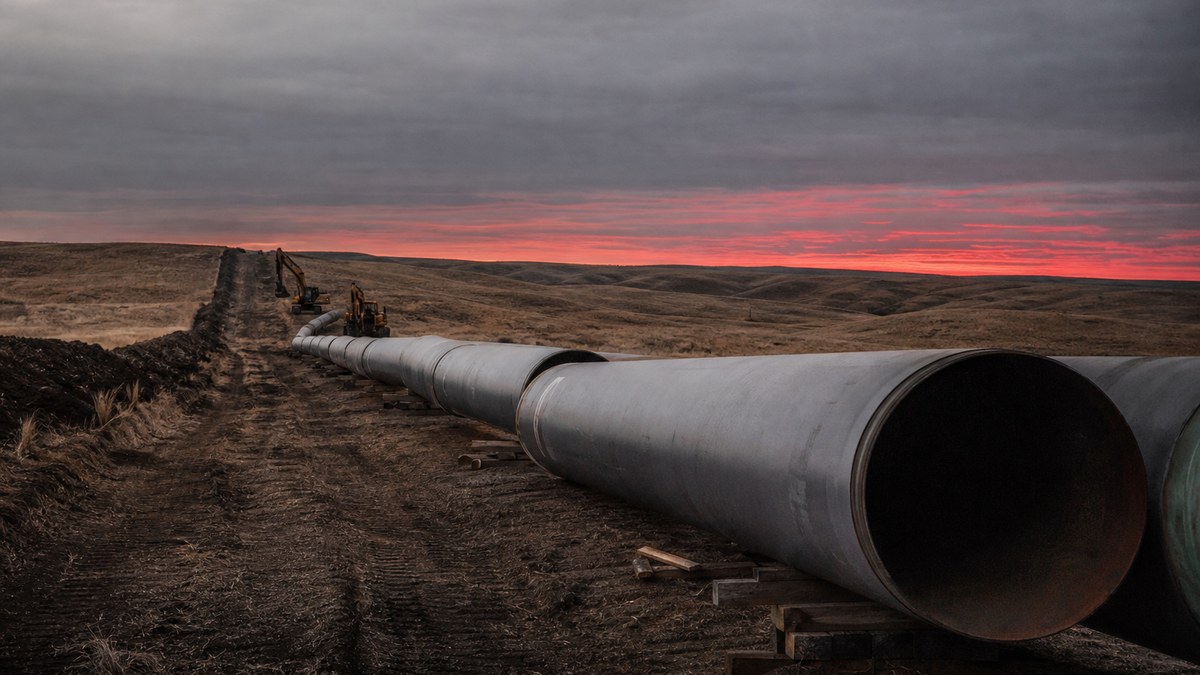
Bakken East is a proposed natural gas transmission pipeline from WBI Energy, a subsidiary of MDU Resources, running about 350 miles from McKenzie County in the Bakken to near Fargo. MDU made a positive final investment decision on September 30, 2026. The line is still in federal review: Phase I is targeted for late 2029 and Phase II for late 2030.
- Developer: WBI Energy Transmission, Inc., part of MDU Resources (Bismarck).
- Status: company final investment decision on September 30, 2026; in FERC's pre-filing process (docket PF26-4-000) since February 12, 2026; not yet approved by FERC.
- Size: about 350 miles of mainline (353.1 miles in FERC's May 2026 scoping notice) plus about 21 miles of laterals.
- Capacity: initial design of 1.4 Bcf/d; estimated cost $2.7–3.2 billion.
- Timeline: construction over the 2028–2030 seasons; Phase I late 2029, Phase II late 2030.
- State role: the North Dakota Pipeline Authority will buy about 11% of initial capacity, backed by a $50 million-a-year, 10-year commitment approved in August 2025.
Every barrel of Bakken crude comes out of the ground with natural gas attached. For years that associated gas was the Bakken's weak point: when processing plants or pipelines filled up, the gas was flared, and the state's gas capture rules could hold back oil production. In 2026 North Dakota is producing more gas than ever, and the systems that carry it out of the basin are close to full. That is why the Bakken East pipeline has become the most closely watched infrastructure project in the state.
In our overview of new Bakken projects we called gas takeaway the single biggest constraint on Bakken activity. This article goes deeper on the project that does the most to relieve it. It covers the route and counties, the capacity and cost, where the project sits in the federal approval process, how the State of North Dakota is involved, how it compares with the competing pipeline proposals, and the practical questions landowners and service companies are asking.
What is the Bakken East pipeline?
Bakken East is a high-pressure interstate natural gas transmission pipeline proposed by WBI Energy, the pipeline subsidiary of Bismarck-based MDU Resources. It would carry processed natural gas from the Bakken in western North Dakota east across the state to an existing WBI compressor station near Mapleton, just west of Fargo. Along the way it would deliver gas to central North Dakota, the Bismarck area, Jamestown and the Red River Valley.
The North Dakota Pipeline Authority's executive director, Justin Kringstad, has described it as the first direct, large-scale connection between the gas supply in western North Dakota and the demand centers in the central and eastern parts of the state. Until now, most Bakken gas that leaves the basin has moved south or east on interstate lines toward markets outside North Dakota, while much of eastern North Dakota is served by gas that originates elsewhere.
On September 30, 2026, MDU announced that its board had reached a positive final investment decision (FID) after WBI secured customer commitments. An FID is a company decision to fund the project. It is not a regulatory approval. The pipeline still needs a certificate from the Federal Energy Regulatory Commission (FERC) before construction can begin.
Where will the Bakken East pipeline run?
The mainline starts in McKenzie County near Watford City and runs east to the Mapleton area in Cass County. FERC's Notice of Scoping, issued May 5, 2026, lists nine North Dakota counties along the proposed route:
| County | Area | What the May 2026 FERC notice shows |
|---|---|---|
| McKenzie | Watford City, Bakken core | Western start of the mainline; receipt points from the gas gathering and processing system |
| Dunn | Killdeer area | Mainline; existing compression in the region |
| Mercer | Beulah, Hazen | Proposed new Beulah compressor station |
| Oliver | Center | Proposed new Center compressor station |
| Burleigh | Bismarck area | Mainline; Phase I ends in central North Dakota north of Bismarck |
| Kidder | Steele area | Mainline |
| Stutsman | Jamestown | Mainline; Spiritwood industrial area lateral nearby |
| Barnes | Valley City | Mainline |
| Cass | Casselton, Mapleton | Eastern end at the existing Mapleton compressor station |
Earlier project descriptions, reported by the North Dakota Monitor in November 2025, described Phase I running from McKenzie County to the Washburn area and Phase II continuing to Mapleton, with planned laterals to the Spiritwood industrial park near Jamestown and to Ellendale, home of a large data center campus. Prairie Public's October 2026 reporting describes Phase I as Watford City to just north of Bismarck. The exact alignment is still being refined in the federal process, so landowners should treat any route map as preliminary until FERC issues its environmental document.
How big is Bakken East, and what will it cost?
MDU's September 30, 2026 announcement put the estimated cost at $2.7 billion to $3.2 billion and the initial design capacity at 1.4 billion cubic feet per day (Bcf/d), with flexibility to expand as demand grows. The DMR's September 2026 Director's Cut lists the proposal at 1.4 to 1.7 million dekatherms per day. For scale, the state produced about 3.62 Bcf/d of natural gas in July 2026, so Bakken East alone could carry well over a third of today's statewide output.
FERC's May 2026 scoping notice gives the most detailed physical description published so far:
- Mainline: 353.1 miles of new greenfield pipe in 42-inch, 36-inch and 30-inch diameters.
- Laterals: eight new laterals in 30-, 24- and 20-inch diameters, totaling 21.2 miles.
- Compression: three new compressor stations (Beulah, Center and Alliance) and added compression at the existing Spring Creek, Elkhorn Creek and Mapleton stations. MDU's FID release refers to four new stations and work at three existing ones, so the station count may still change.
- Other facilities: 6 receipt stations, 10 delivery stations, 8 interconnect or transfer stations and 28 mainline valves.
- Land: about 8,500 acres disturbed during construction and about 2,700 acres retained for permanent operation.
MDU says it is still evaluating financing, including debt, equity and possible partnerships. No shipper names have been published.
When will Bakken East be built?
The schedule has been consistent since 2025, and the FID keeps it on track. Here is the timeline as reported by the company, the state and FERC:
| Milestone | Date | Status (Oct 2026) |
|---|---|---|
| Development work begins | Early 2025 | Done |
| NDIC votes to support with $50M/yr capacity commitment | August 2025 | Done |
| FERC approves entry into pre-filing (PF26-4-000) | February 12, 2026 | Done |
| FERC scoping meetings (Watford City, Hazen, Bismarck, Jamestown, Casselton) | May 19 – June 4, 2026 | Done; comment period closed June 4 |
| MDU final investment decision | September 30, 2026 | Done |
| Formal FERC certificate application | Q4 2026 (expected) | Pending |
| FERC certificate | Early 2028 (company target) | Pending |
| Construction | 2028–2030 seasons | Planned |
| Phase I in service (Bakken to central ND) | Late 2029 | Planned |
| Phase II in service (to Mapleton, near Fargo) | Late 2030 | Planned |
The most important date for the next year is the formal FERC application. Once WBI files, FERC will prepare an environmental document and accept formal comments and motions to intervene. The company told the North Dakota Monitor in 2025 that it would look to receive its certificate in early 2028, with construction beginning in the second half of 2028.
An FID before the federal application is a strong signal. It means MDU has enough signed customer demand to commit capital, and that the State of North Dakota is a committed anchor customer rather than a cheerleader. The remaining risks are the normal ones for a large interstate line: FERC timing, construction cost inflation and route changes. For planning purposes we would treat 2028 as the year work begins in earnest, and 2027 as the year contracts, easements and supply chains get locked in.
Why does North Dakota need Bakken East?
The short answer is that gas production keeps rising and takeaway has not kept up. According to the DMR's September 21, 2026 Director's Cut, North Dakota produced 3.621 Bcf/d of natural gas in July 2026, up 1.12% from June, while oil production was 1,156,641 barrels per day. The state reached an all-time high of 20,072 producing wells. Statewide gas capture slipped to 95.3%, and flaring rose to about 173 million cubic feet per day. The DMR attributes most flaring to a lack of pipelines and constraints on existing infrastructure.
North Dakota's gas capture goal is 91%, and the industry is well above it. But Kringstad warned at the 2026 Williston Basin Petroleum Conference that producers "will not allow flaring to ramp up to the levels it was years ago," and that without new takeaway, capital could move to other basins. In other words, gas pipes now decide how many oil wells get drilled.
There is also a demand side. Eastern and central North Dakota are seeing new interest in gas-fired power generation, agricultural processing and data centers. WBI has said its potential customers include utilities, industrial users and data center developers. Bakken East would give those users direct access to North Dakota gas rather than gas routed in from other states.
| Indicator (DMR, July 2026) | Figure | Why it matters for Bakken East |
|---|---|---|
| Gas production | 3.621 Bcf/d | Record volumes need new outlets |
| Gas capture | 95.3% statewide, 95.6% Bakken | Above the 91% goal, but slipping slightly |
| Flaring | ~173 MMcf/d | Rose month over month; blamed mainly on pipeline limits |
| Oil production | 1,156,641 bbl/d | 5.15% above the state revenue forecast |
| Producing wells | 20,072 (record) | More wells mean more associated gas |
| Rigs / permits / completions | 24 rigs; 93 permits; 74 completions | Activity that depends on takeaway |
How is the State of North Dakota involved?
The state's role runs through the North Dakota Industrial Commission (NDIC), which also acts as the North Dakota Pipeline Authority. The 2025 Legislature strengthened the Pipeline Authority's power to purchase pipeline capacity, so the state can act as an anchor shipper and later transfer that capacity to private users.
- August 2025: the NDIC voted unanimously to back WBI's project, choosing it over a competing proposal, with a firm capacity commitment of $50 million per year for 10 years.
- September 30, 2026: after the FID, the Commission directed the Pipeline Authority to execute a precedent agreement to buy capacity equal to about 11% of the project's initial design capacity. (In November 2025, Kringstad had estimated the state's share at 15% to 17% of capacity; the share fell as the design grew.)
The state's stated goals are to support continued gas capture, improve energy reliability and expand access to North Dakota gas in communities that have lacked it. Supporters have also argued, as reported by KFYR in May 2026, that a full gas system could generate more than $1 billion a year in tax revenue and protect thousands of jobs by keeping rigs running. Treat that figure as an advocacy estimate rather than an official forecast.
How does Bakken East compare with the other gas pipelines?
Bakken East is not the only proposal to move Bakken gas east. The DMR tracks three projects:
| Project | Developer | Capacity | Route | Status (Oct 2026) |
|---|---|---|---|---|
| Bakken East | WBI Energy (MDU Resources) | 1.4 Bcf/d initial | McKenzie County to Mapleton (~350 mi) | FID Sept 30, 2026; FERC pre-filing; Phase I late 2029 |
| Intensity / Rainbow line | Intensity Infrastructure Partners and Rainbow Energy Center | ~1.1 MMDth/d (Phase I); 430,000 Dth/d (Phase II) | Watford City area to Washburn (136 mi, 36-inch), then to Casselton (208 mi, 30-inch) | Phase I advanced with firm commitments (Jan 2026); DMR lists Phase I July 2029 |
| Bakken xPress / Bison XPress | TC Energy (Northern Border); DMR also lists Kinder Morgan | 300,000 Dth/d | Expansion of existing systems, incl. Manning compressor station, Dunn County | Under construction since April 2025; May 2026 in-service target delayed |
The projects are not mutually exclusive. Bison XPress is a near-term expansion of existing systems. Bakken East and the Intensity/Rainbow line both target in-state demand, and the Intensity line is closely tied to power generation near Washburn and Coal Creek Station. Whether both large lines get built at full scale depends on how much firm demand develops in central and eastern North Dakota by the end of the decade.
What should landowners along the route know?
Most of the questions we hear about Bakken East come from landowners and farm families along the proposed corridor. FERC's scoping notice and the agency's landowner guidance answer several of them directly:
- Survey permission is not an easement. WBI reported in November 2025 that it had survey permission from 98% of mainline landowners, 93% along the Spiritwood lateral and 53% along the possible Ellendale lateral, but no easements had been signed and the design was not final.
- You are not required to sign. FERC's notice states that WBI may contact landowners to negotiate easements, and that landowners are not required to sign.
- Eminent domain comes with a certificate. If FERC approves the project, the Natural Gas Act gives the company eminent domain authority. If no agreement is reached, the company could start condemnation proceedings in court, where compensation is set under state law. FERC does not oversee eminent domain cases.
- Comments still matter. The scoping comment period closed June 4, 2026, but there will be further opportunities to comment and intervene after WBI files its formal application. FERC's Office of Public Participation (202-502-6595) helps landowners navigate the process, and WBI lists a landowner line at 888-451-1119.
- Issues FERC will study include soils, water resources and wetlands, wildlife, endangered species, cultural resources, land use, air quality and noise, and reliability and safety, plus crossings of navigable rivers, flood control structures and public lands.
Easement terms often matter as much as the price: restoration standards for cropland and drain tile, depth of cover, temporary workspace, access roads, crop-loss payments, future-use restrictions and what happens if the line is later expanded. We are not lawyers, and landowners should get independent legal and appraisal advice before signing anything.
In our experience in the Bakken, the projects that go smoothly are the ones where landowners, contractors and the operator understand each other's constraints early. Landowners along Bakken East have time on their side: nothing is built before 2028, and the federal process is still open. The best use of 2026 and 2027 is to understand the route on your land, document drainage and field conditions, and decide what terms matter to you before an easement offer arrives.
What does Bakken East mean for oilfield service companies and contractors?
A 350-mile, multi-diameter pipeline with new compressor stations is a multi-year construction program. Even though large interstate lines are usually built by specialized mainline contractors, they pull in a long list of regional suppliers and services:
- Aggregate and site work: access roads, laydown yards, compressor and valve-station pads all need rock, gravel and scoria. This is the business our team knows from Kota.
- Water: new pipe is pressure-tested with water before service. Sourcing, transferring and handling that water is the kind of work we have done through Bullrock Water.
- Waste handling: construction, drilling under rivers and roads, and station work generate fluids and solids that need compliant disposal, the field Bullrock worked in.
- Equipment, parts and gaskets: compressor stations, meter stations and interconnects use specialized equipment, flanges and sealing components, the niche served by Raptor Supply and Raptor Gaskets.
- Housing, fuel, trucking and fabrication in towns along the route, from Watford City to Jamestown and Casselton.
Construction itself is planned for 2028–2030, but contracting decisions are typically made well before the first pipe is welded. Service companies that want a role should be building relationships with the developer and its prime contractors during 2027.
Planning around Bakken East?
Raptor Energy Partners advises operators, landowners, developers and service companies on energy projects in North Dakota, drawing on businesses we have built and operated in the Bakken. Tell us what you are working on.
Talk to Tom and BrettWho should pay attention to Bakken East?
Operators and producers
New takeaway reduces the risk that gas constraints cap oil development or force curtailments. Producers should watch which processing plants and receipt points connect to Bakken East and how capacity is allocated, including capacity the state may resell.
Landowners and mineral owners
Surface owners along the route face easement decisions. Mineral owners across the Bakken benefit indirectly: better gas takeaway supports continued drilling and can reduce flaring that affects gas royalties.
Service companies and contractors
Three construction seasons across nine counties mean demand for aggregate, water, waste handling, trucking, fabrication, housing and parts. Early positioning matters.
Developers, utilities and investors
Firm gas in central and eastern North Dakota changes the economics for gas-fired power, ag processing and data centers near Bismarck, Jamestown and Fargo. Anyone evaluating projects in those areas should treat 2029–2030 gas availability as a planning input, while remembering that the pipeline is not yet approved. Nothing here is investment advice.
Project status at a glance
| Item | Proposed / approved / under construction | Source and date |
|---|---|---|
| Bakken East (WBI Energy) | Proposed; company FID made; not yet FERC-approved | MDU release and NDIC, Sept 30, 2026; FERC |
| State capacity purchase (~11%) | Approved by NDIC; precedent agreement directed | NDIC, Sept 30, 2026 |
| Intensity / Rainbow pipeline | Proposed; Phase I backed by firm commitments | Pipeline & Gas Journal, Jan 2026; DMR, Sept 2026 |
| Bison XPress / Bakken xPress | Under construction; in-service delayed from May 2026 | Pipeline & Gas Journal, Apr 2026; DMR, Sept 2026 |
Frequently asked questions
What is the Bakken East pipeline?
Bakken East is a proposed natural gas transmission pipeline by WBI Energy, a subsidiary of MDU Resources, running about 350 miles from McKenzie County in the Bakken to near Fargo. It is designed to carry 1.4 billion cubic feet of gas per day and is estimated to cost $2.7 billion to $3.2 billion.
Has the Bakken East pipeline been approved?
Not yet. MDU made a positive final investment decision on September 30, 2026, which is a company funding decision. The project is in FERC's pre-filing process under docket PF26-4-000, and WBI expects to file its formal application in the fourth quarter of 2026.
When will Bakken East be finished?
Phase I, from the Bakken to central North Dakota, is targeted for late 2029. Phase II, to the Mapleton compressor station near Fargo, is targeted for late 2030. Construction is planned over the 2028 to 2030 seasons.
Which counties does Bakken East cross?
FERC's May 2026 scoping notice lists McKenzie, Dunn, Mercer, Oliver, Burleigh, Kidder, Stutsman, Barnes and Cass counties in North Dakota. The final route may change during the federal review.
How much capacity is North Dakota buying on Bakken East?
The North Dakota Pipeline Authority was directed on September 30, 2026 to buy capacity equal to about 11% of the initial design. The Industrial Commission approved a firm commitment of 50 million dollars per year for 10 years in August 2025, and the state plans to transfer that capacity to private users.
Can WBI Energy use eminent domain for Bakken East?
Only if FERC approves the project. A FERC certificate gives the company eminent domain authority under the Natural Gas Act, and if no agreement is reached, compensation would be set by a court under state law. Landowners are not required to sign an easement during negotiations.
How is Bakken East different from the Intensity and Rainbow pipeline?
They are separate proposals. Intensity Infrastructure Partners and Rainbow Energy Center plan a 344-mile line in two phases, from near Watford City to Washburn and then to Casselton. Bakken East is WBI Energy's larger line to the Mapleton area, and it is the project the state chose to back with a capacity commitment.
Why does Bakken gas need a new pipeline?
North Dakota produced a record 3.621 billion cubic feet of gas per day in July 2026, and the DMR attributes most flaring to a lack of pipeline capacity. Without new takeaway, gas constraints can limit oil drilling. Bakken East also brings North Dakota gas to new users in central and eastern parts of the state.
Will Bakken East reduce flaring in North Dakota?
That is one of its main goals. Statewide gas capture was 95.3% in July 2026, above the state's 91% goal, but flaring rose to about 173 million cubic feet per day. More takeaway capacity is intended to keep capture high as production grows.
How can Raptor Energy Partners help with Bakken East?
We advise operators, landowners, developers and service companies on energy projects, land and partnerships in North Dakota, drawing on businesses we have built and operated in oilfield waste, water, aggregate and supply. Email tom@raptorenergypartners.com or brett@raptorenergypartners.com.
Keep reading
Sources
- MDU Resources / WBI Energy, WBI Energy reaches positive final investment decision to build Bakken East pipeline (September 30, 2026).
- North Dakota Industrial Commission, Industrial Commission applauds final investment decision by WBI Energy for Bakken East pipeline (September 30, 2026).
- Federal Energy Regulatory Commission, Bakken East Pipeline Project (docket PF26-4-000, page updated August 25, 2026) and Notice of Scoping (May 5, 2026).
- North Dakota Department of Mineral Resources, Director's Cut, September 21, 2026 (July 2026 production, gas capture, flaring, pipeline projects).
- Prairie Public, WBI makes final investment decision on the Bakken East project (October 3, 2026).
- KFYR-TV, Major natural gas pipeline gets green light in North Dakota (October 2, 2026) and A time to act: natural gas production in the Bakken (May 21, 2026).
- North Dakota Monitor, Natural gas pipeline developer to sign up western North Dakota suppliers, eastern users next year (November 6, 2025).
- Pipeline & Gas Journal, WBI Energy approves $3 billion, 350-mile Bakken East pipeline (September 2026), Phase I of 344-mile North Dakota gas pipeline advances with firm commitments (January 6, 2026) and Bakken gas capacity set to rise as Bison XPress nears full service (April 15, 2026).
This article is general information about a proposed energy project in North Dakota, based on the sources listed and current as of October 20, 2026. Project routes, costs, capacities and dates can change during regulatory review. It is not investment, legal or financial advice, and nothing here is an offer to sell or a solicitation to buy any security. Landowners should seek independent legal advice before signing any easement.